
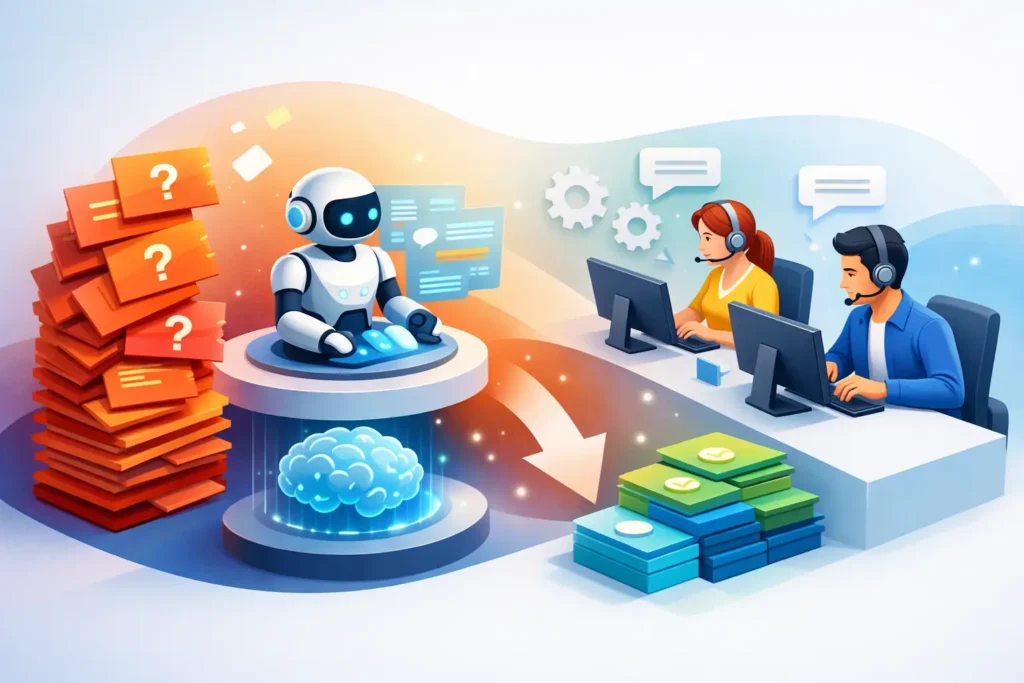
Support leaders usually ask the wrong first question. It is not simply can AI reduce ticket volume. The better question is which tickets should disappear, which should move to self-service, and which still need a skilled agent. That distinction matters because lower volume is only useful if customer effort goes down with it.
For mid-sized and enterprise support teams, AI can reduce ticket volume in measurable ways. But the result depends on process design, content quality, routing logic, and governance. If those pieces are weak, AI often shifts work around instead of removing it. You may see fewer inbound tickets on paper while repeat contacts, escalations, or agent handling time quietly rise.
Can AI reduce ticket volume in a real support operation?
Yes, but usually through a combination of smaller improvements rather than one dramatic change. In most environments, AI lowers ticket volume by intercepting routine requests, guiding users to the right answer earlier, and removing avoidable friction from the support journey.
That means the biggest gains tend to come from predictable, high-frequency interactions. Password resets, order status, billing questions, appointment updates, account access, basic product how-to requests, and policy clarification are common examples. If a large share of your queue falls into these categories, AI has room to help.
If your volume is driven by complex exceptions, broken internal workflows, or product defects, AI has a smaller impact. It can still improve triage and speed, but it will not erase the underlying demand. In those cases, ticket volume is a symptom of operational issues, not a channel problem.
Where AI actually cuts ticket demand
The most effective use cases are usually unglamorous. They remove repetitive contacts that customers never wanted to submit in the first place.
Better self-service before a ticket is created
Many support teams already have help center content, but customers still open tickets because search is weak, articles are outdated, or the answer is buried in internal language. AI can improve article recommendations, understand natural-language questions, and present the next best answer before a form is submitted.
This is where a lot of preventable demand lives. A customer may not need an agent. They may just need the right article, surfaced at the right time, in plain language.
Conversational bots for routine requests
A bot can reduce volume when it resolves simple issues end to end. That includes tasks like checking order status, confirming account details, collecting structured intake data, or walking a user through a known fix.
The key is narrow scope. Bots perform best when the task is clear, the system integrations are reliable, and the exit path to a human is well defined. Broad, vague bots that try to handle everything often create frustration and recontact.
Smarter routing that prevents duplicate tickets
Not all ticket reduction happens before submission. AI can classify intent, detect urgency, identify language, and route requests correctly the first time. That reduces the common operational failure where customers submit multiple tickets because the first one stalled or landed with the wrong team.
This is less visible than chatbot deflection, but it matters. Poor routing creates avoidable volume through delay, handoffs, and duplicate outreach.
Agent assistance that shortens repeat contact cycles
AI can also reduce future volume by helping agents resolve issues more completely. Suggested replies, article recommendations, next-step prompts, and case summaries can improve consistency and reduce missed information.
If first-contact resolution improves, total ticket demand often falls over time. Customers stop coming back for the same issue, and agents spend less time cleaning up incomplete cases.
Why some AI projects fail to reduce ticket volume
The usual reason is simple. Teams deploy AI on top of broken service design.
If your forms collect poor information, your knowledge base is outdated, your workflows are inconsistent, and your ownership rules are unclear, AI will amplify the confusion. Customers get faster wrong answers. Agents receive faster bad tickets. Reporting becomes harder to trust.
Another common issue is using ticket deflection as the only success metric. A bot may prevent ticket creation in the moment, but that does not mean the issue was resolved. Customers may switch channels, call instead of chat, or submit the same request later with more frustration. True volume reduction should be measured across the full customer journey, not one channel in isolation.
There is also a governance problem. AI models and automations need maintenance. Content changes. Policies shift. Product lines expand. Without ongoing review, an AI layer that worked six months ago can slowly degrade and create noise.
What to measure if you want a real answer
If leadership wants to know whether AI is working, ticket count alone is not enough. You need a broader operational view.
Start with contact rate by issue type. This tells you whether AI is reducing demand in the categories it was designed to address. Then look at self-service success, containment rate for bot interactions, first-contact resolution, transfer rate, and repeat contact within a defined period.
You should also watch customer effort signals. CSAT after bot interactions, abandonment during digital journeys, and escalation patterns will show whether volume is actually disappearing or just being displaced.
For enterprise environments, comparing pre- and post-AI performance by intent is often the clearest method. AI may reduce simple billing contacts by 35 percent while doing almost nothing for technical troubleshooting. That is still a good result, but only if the scope is understood correctly.
Can AI reduce ticket volume in Zendesk?
In Zendesk environments, AI can support ticket reduction when it is tied to knowledge, routing, automation, and reporting rather than treated as a standalone feature. The platform can surface relevant help content, power bot workflows, classify requests, and trigger downstream actions that remove manual effort.
But configuration quality matters. If macros are inconsistent, triggers overlap, forms are poorly structured, or reporting taxonomy is weak, the AI layer will not have a clean operating environment. This is one reason many organizations need more than feature enablement. They need operational design.
A practical Zendesk strategy usually starts with a few steps. Identify the top contact drivers. Clean up knowledge content around those issues. Define where AI should answer, where it should collect information, and where it should hand off. Then measure outcomes by intent, not by overall volume alone.
For organizations with complex support operations, this work often sits across CX, IT, and service owners. Blue Glass Solutions typically sees better results when AI design is paired with workflow cleanup and governance, because ticket demand is rarely caused by one thing.
The trade-offs leadership should expect
Reducing volume is not always the same as improving service. Some contacts should not be deflected. High-risk financial questions, sensitive healthcare requests, emotionally charged complaints, and complex technical incidents often need a human path early.
There is also a cost trade-off. AI can lower repetitive workload, but it requires investment in implementation, testing, training data, content management, and operational oversight. The return is strongest when volume is high enough, issue types are repeatable enough, and teams are disciplined enough to maintain the system.
Another trade-off is visibility. As automation absorbs more simple requests, the remaining queue becomes more complex. That can make average handle time rise even while total performance improves. Leaders need to interpret metrics in context or they may think the team is getting less efficient when the opposite is true.
A practical standard for deciding if AI is worth it
If you want a simple decision framework, look at three conditions. First, do you have enough repeatable demand to automate? Second, do you have usable knowledge and stable workflows behind the experience? Third, can you measure outcomes across channels and over time?
If the answer to all three is yes, AI can reduce ticket volume in a meaningful and sustainable way. If one or more answers are no, the better move may be process redesign first and AI second.
That is usually the difference between a short-term pilot and a durable improvement. AI works best when it removes friction from a support system that already knows what good service looks like.
The useful goal is not fewer tickets at any cost. It is fewer unnecessary tickets, faster paths for the right ones, and a support operation that scales without adding avoidable effort for customers or agents.