
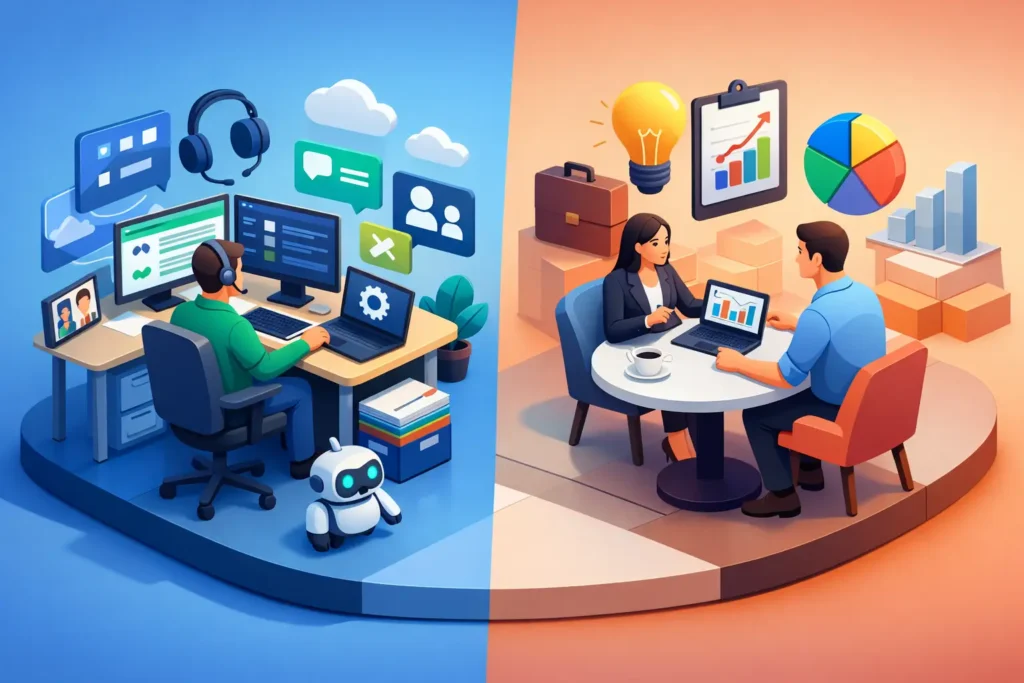
A Zendesk instance can look stable while creating hidden operational costs. Tickets may be routed inconsistently, agents may rely on workarounds, reports may not answer leadership questions, and automation may have grown without clear ownership. The decision between an outsourced Zendesk admin vs consultant starts with the type of problem your organization needs to solve.
An outsourced administrator provides ongoing operational capacity. A consultant provides specialized analysis, design, and change leadership for a defined initiative. Both can improve the platform, but they are not interchangeable roles. Selecting the wrong model can leave a team with either too little day-to-day support or a well-designed plan that no one has the capacity to maintain.
Outsourced Zendesk Admin vs Consultant: The Core Difference
An outsourced Zendesk admin functions as an extension of your internal support operations or IT team. Their work is continuous and practical: managing user access, maintaining forms and fields, reviewing triggers, resolving configuration issues, supporting reporting requests, and handling routine changes as teams and processes evolve.
This model is useful when Zendesk is already central to daily operations but internal ownership is limited. A growing support organization may have a support leader who understands the business but lacks time for administration. An IT team may own several enterprise platforms and need dependable Zendesk coverage without hiring a full-time administrator. In these cases, consistent administration helps prevent small requests, outdated workflows, and unreviewed automation from becoming larger operational problems.
A Zendesk consultant is typically engaged for a project, decision, or transformation. The consultant assesses current operations, gathers requirements, identifies process gaps, designs a future-state configuration, and guides implementation. The work may include an initial Zendesk rollout, a major workflow redesign, omnichannel routing, AI and chatbot strategy, contact center performance review, system governance, or a technology roadmap.
The deliverable is not simply platform maintenance. It is a better operating model supported by Zendesk. A consultant should connect configuration choices to measurable business outcomes such as reduced effort, improved routing accuracy, faster resolution, better self-service adoption, or more reliable customer experience reporting.
When an Outsourced Zendesk Admin Is the Better Fit
Choose ongoing administration when the platform design is generally sound and the immediate issue is execution capacity. Your organization may have a clear support model, established service expectations, and a working backlog of improvements, but no one has enough time to manage it properly.
Common signs include recurring requests for user updates, field changes, form adjustments, trigger revisions, reporting support, and help center maintenance. These requests are individually manageable, yet they accumulate quickly. Without a dedicated owner, teams often postpone them, make inconsistent changes, or give broad administrative permissions to people who should not be responsible for platform governance.
An outsourced admin is also a strong option after a major implementation. New Zendesk environments often need active management during the first several months as teams refine routing, add reporting, update macros, adjust service-level targets, and respond to agent feedback. Ongoing support protects the investment made during implementation and reduces the risk of configuration drift.
The limitation is that an administrator should not be expected to independently solve a broad strategic problem without adequate discovery. If leaders do not agree on support processes, channel strategy, ownership rules, or success measures, assigning an admin to make incremental changes can reinforce a flawed model. Administration keeps a system healthy. It does not automatically define where the system should go next.
When a Zendesk Consultant Is the Better Fit
A consultant is the better fit when the organization needs to make higher-consequence decisions or address issues that cross teams, systems, and customer journeys. This is common when a company is implementing Zendesk for the first time, replacing a legacy platform, expanding into voice or messaging, launching AI capabilities, or standardizing support across business units.
Consulting is also appropriate when the source of a problem is unclear. For example, a high ticket backlog may result from staffing constraints, poor case categorization, ineffective routing, weak self-service content, product defects, reporting gaps, or a combination of factors. Adding more triggers before understanding the underlying workflow can create more complexity rather than meaningful improvement.
A qualified consultant can examine the current state, facilitate requirements gathering, map the customer and agent experience, and create a prioritized plan. The scope may include automation design, smart routing, knowledge management, chatbot strategy, data structure, dashboards, governance, and training. The purpose is to make deliberate design choices before configuration work begins.
Consulting engagements usually have a defined beginning and end. That makes them well suited for change programs, but less suited for handling a steady stream of small requests after launch. Organizations should plan for who will own the platform when the consultant’s project is complete.
Compare the Work, Not Just the Job Titles
Job titles can be misleading. Some providers offer both services, and some internal teams use “admin” for a role that also owns strategy. A better approach is to evaluate the work your organization needs over the next six to twelve months.
If most work involves repeatable maintenance, request fulfillment, quality checks, and incremental optimization, an outsourced admin is likely the more efficient choice. Define service expectations clearly, including request intake, approval steps, response times, documentation, and escalation paths. Ongoing administration works best when the provider understands who can request changes and who has final decision authority.
If the work requires stakeholder alignment, process redesign, technical architecture, or a measurable improvement plan, consulting is more appropriate. Ask how the consultant will validate requirements, identify trade-offs, document recommendations, and support adoption. A configuration decision can affect reporting, agent experience, data quality, compliance, and customer effort, so the discovery process matters as much as the build work.
Cost should be considered in context. An outsourced admin may be more economical than a full-time hire when demand is variable or specialized skills are needed only part time. A consultant may require a higher short-term project investment, but can prevent expensive rework when a major implementation or redesign is underway. The lower hourly rate is not always the lower total cost if the engagement does not address the real issue.
The Hybrid Model Often Delivers the Best Result
Many mid-sized and enterprise organizations need both models at different stages. A consultant can establish the future-state design, clean up inherited workflows, define governance, and build a prioritized roadmap. An outsourced admin can then maintain the environment, complete approved enhancements, monitor system health, and surface patterns that indicate the roadmap needs revision.
This sequence is especially useful for organizations with complex support environments. A healthcare organization may need careful controls around user access and workflows. A retailer or eCommerce company may need rapid adjustments during seasonal peaks. A technology company may need support processes tied to product releases and incident management. The right level of strategic input and administrative coverage will vary, but ownership should remain clear.
Blue Glass Solutions can support both sides of that operating model, from advanced contact center design and automation through on-demand Zendesk administration. The value comes from matching the engagement to the operational need instead of treating every Zendesk request as either a simple configuration task or a major consulting project.
Questions to Ask Before You Choose
Start with the backlog. Are requests mostly known, approved, and repeatable, or do they reveal disagreement about how support should operate? Known work favors administration. Ambiguous or cross-functional work favors consulting.
Next, consider internal decision-making. An outsourced admin can move efficiently when a product owner or support leader can make timely decisions. If several teams must agree on customer policies, intake processes, routing rules, or reporting definitions, a consultant may be needed to structure those decisions.
Also assess the condition of the current Zendesk environment. A well-governed instance with clear documentation can transition smoothly to ongoing outsourced support. An environment with duplicate triggers, unclear field ownership, inconsistent reporting, and undocumented exceptions may need an assessment and cleanup project first.
Finally, define success in operational terms. For administration, success may mean faster completion of approved requests, fewer configuration errors, current documentation, and consistent governance. For consulting, success may mean a validated design, reduced manual handling, improved service-level performance, usable reporting, or a roadmap that leadership can act on.
The practical choice is not about which role sounds more senior. It is about whether your team needs reliable hands on the platform, a clearer plan for changing it, or a deliberate combination of both. Begin with the work that is being delayed today, then choose the model that gives it accountable ownership.