
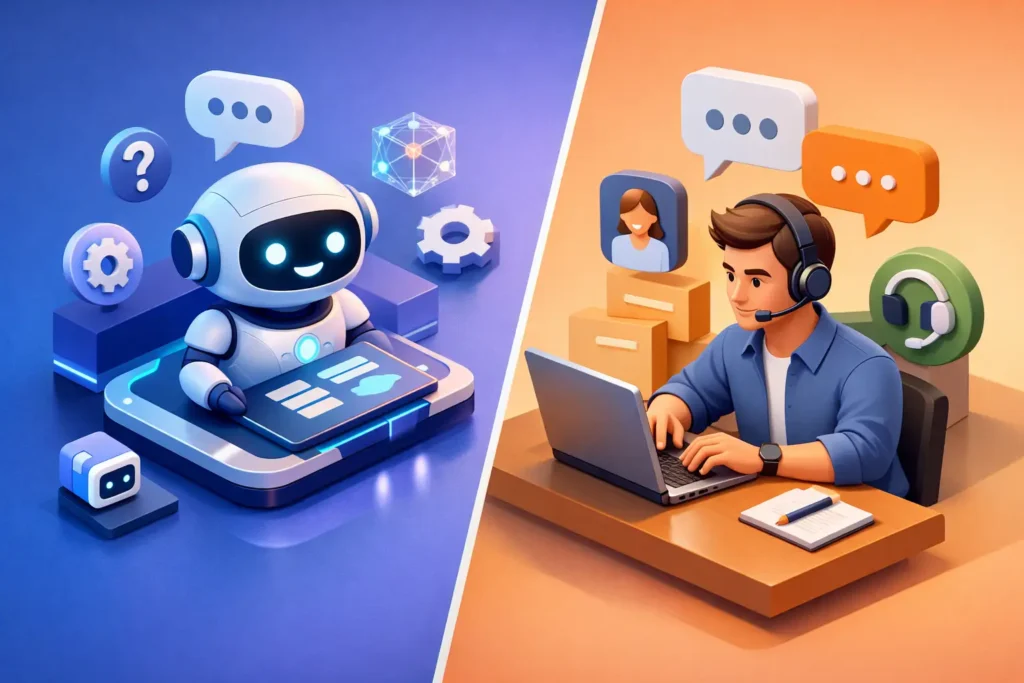
A support leader usually asks the AI chatbot vs live chat question for one reason: the current model is breaking somewhere. Queue times are climbing, agents are stuck answering repeat questions, customers are bouncing between channels, or leadership wants lower cost without a drop in service quality. The real decision is not which option wins in theory. It is which one fits the work your support organization actually handles.
For mid-sized and enterprise teams, this is rarely a binary choice. AI can reduce volume and improve responsiveness. Live chat can protect revenue, handle nuance, and recover difficult interactions. The challenge is deciding where automation creates value and where human support is still the better operational choice.
AI chatbot vs live chat: the core difference
An AI chatbot handles conversations through automation. Depending on the setup, it may answer common questions, guide users through workflows, collect context, classify intent, route the case, or resolve simple issues without an agent. Its strength is scale. It can manage large volumes at any hour without adding headcount.
Live chat connects the customer to a human agent in real time. Its strength is judgment. A trained agent can interpret ambiguous requests, respond to emotion, adapt to exceptions, and make decisions across systems and policies.
That distinction matters because support work is not all the same. Some contacts are repetitive and rules-based. Others are complex, high-stakes, or emotionally charged. The wrong channel for the wrong interaction increases effort for both the customer and the team.
Where AI chatbots perform well
AI works best when the request has a clear pattern, a limited number of acceptable outcomes, and data available to support the answer. Order status, password reset help, appointment reminders, account verification steps, store hours, basic policy questions, and simple triage are common examples.
In those cases, speed matters more than empathy. Customers often want a direct answer without waiting in queue. If the bot can resolve the issue in one interaction, it improves containment and reduces agent workload at the same time.
AI chatbots are also useful before the conversation reaches an agent. They can gather account details, identify the issue type, and route the request based on urgency, language, product line, or customer segment. Even when the bot does not fully resolve the issue, it can shorten handling time by giving the agent better context at handoff.
This is where many support organizations see practical value first. Full automation gets attention, but effective triage often produces faster results with less risk.
Where live chat remains the better option
Live chat is still the better fit when the issue requires investigation, policy interpretation, negotiation, or emotional intelligence. Billing disputes, technical troubleshooting, service failures, complaints, escalations, and high-value sales or retention interactions usually need a person.
A human agent can ask better follow-up questions when the customer is unclear. They can recognize when a standard answer is likely to make the situation worse. They can also balance customer expectations against internal constraints in a way that an automated flow often cannot.
This matters even more in regulated or complex environments. In healthcare, financial services, and enterprise technology, the cost of a wrong answer can be higher than the cost of a slower response. Accuracy, auditability, and escalation discipline matter more than simple deflection.
Live chat also protects brand trust during moments that carry more emotion. When a customer is frustrated, confused, or at risk of churn, fast automation is not the same as effective support.
The cost question is real, but it is not simple
Many teams start with cost. AI appears less expensive because it can absorb contact volume without the labor cost of adding agents. That is true to a point, but only if the chatbot is designed well and maintained consistently.
A poorly configured bot can increase repeat contacts, raise transfer rates, and frustrate customers enough to create more expensive downstream work. Deflection that pushes customers into dead ends is not savings. It is cost shifted into another queue.
Live chat is more expensive per interaction because human time is limited and staffing has to match demand. But for the right kinds of conversations, that higher cost may still be the better business choice if it improves resolution quality, retention, or conversion.
The better question is not which channel is cheaper. It is which model lowers total service cost without damaging customer effort, resolution rate, or customer satisfaction.
Customer experience depends on fit, not preference
Some customers prefer self-service. Others want a person immediately. Most are less concerned with channel philosophy than with getting the issue solved quickly and correctly.
That is why AI chatbot vs live chat should be evaluated by interaction type, not by assumptions about what customers say they want. If the issue is simple, automation can feel faster and easier than waiting for an agent. If the issue is complicated, the same bot may feel like an obstacle.
A good support design reduces friction by making the right next step obvious. Customers should not have to fight through automation to reach a person, and agents should not be handling work that could have been resolved automatically in seconds.
The best experiences usually come from a staged model. Start with automation where it adds speed and consistency. Escalate to live support when confidence drops, complexity rises, or customer sentiment turns negative.
How to decide what belongs in each channel
The most effective way to make this decision is to review actual contact data. Look at your highest-volume intents, average handle time, repeat contact patterns, transfer rates, escalation triggers, and CSAT by issue type. That analysis usually shows where automation can succeed and where live coverage is still necessary.
If an interaction is frequent, repetitive, and structured, it is a strong candidate for AI. If it regularly requires exception handling or touches multiple systems, it probably needs an agent. If it starts simple but often becomes complex, a bot can manage intake while live chat handles resolution.
This is also where platform design matters. In Zendesk environments, the value does not come from adding a bot alone. It comes from connecting automation to routing logic, knowledge content, ticket fields, reporting, and escalation workflows. Without that architecture, the chatbot often becomes a disconnected front end rather than part of an operating model.
A practical rollout usually starts with a small set of well-defined intents. Measure containment, transfer quality, first contact resolution, average resolution time, and customer satisfaction. Then expand based on evidence, not optimism.
Common mistakes in the AI chatbot vs live chat decision
One common mistake is treating AI as a replacement strategy instead of a service design decision. Automation should reduce unnecessary effort. It should not exist just to block agent access.
Another mistake is launching a chatbot before the underlying knowledge base, routing rules, and support taxonomy are clean. AI performs better when content is current, categories are clear, and workflows are consistent. If the source material is messy, the customer experience will usually be messy too.
Teams also underestimate governance. AI is not a set-it-and-forget-it channel. It needs tuning, reporting, fallback management, and regular review of failure points. The same is true for live chat staffing models, but the failure modes are different.
The last mistake is measuring success with one metric. High deflection can look good on paper while CSAT drops and repeat contacts rise. Fast live response can also look good while costs remain unsustainable. Decision-makers need a balanced view across efficiency, quality, and experience.
The better model is usually both
For most enterprise support organizations, the answer to AI chatbot vs live chat is not either-or. It is orchestration. AI should handle the work that benefits from speed, consistency, and scale. Live agents should handle the work that requires judgment, empathy, and exception management.
That blended model is usually more resilient than choosing one channel as the default for everything. It helps teams manage growth without adding unnecessary labor, while still protecting the interactions that carry the most operational or customer risk.
This is also the model that tends to age better. As AI capabilities improve, you can expand the scope of automation gradually. As service expectations change, you can refine routing and handoff rules instead of rebuilding the whole support operation.
Blue Glass Solutions works with organizations facing this exact challenge inside Zendesk environments: too much manual effort, inconsistent customer experience, and no clear line between what should be automated and what should remain agent-led. The right answer usually comes from architecture and measurement, not from channel hype.
If your team is evaluating automation, start with the pressure points already showing up in your data. That is usually where the best channel decision becomes obvious.